Monday, May 18, 2026

Yamanote Line Stations Tokyo

Yamanote Line Stations, Tokyo, Japan

Yamanote Line Stations Tokyo.

Anyone spending more than a day or two in Tokyo will almost certainly find themselves aboard the Yamanote Line, the loop railway that forms the circulatory system of the world's largest city. Encircling central Tokyo across 30 stations, the line links many of the capital's most important commercial, entertainment, and transportation hubs, from the neon lights of Shinjuku and Shibuya to the electronics districts of Akihabara and the cultural landmarks surrounding Ueno. Notably, however, several of Tokyo's historic commercial centers - including Ginza, Nihonbashi, and Asakusa - lie just outside its loop.

A complete circuit of the Yamanote Line takes about an hour, but in that time the train passes through some of the busiest urban rail corridors on Earth. Seven of the world's 15 busiest railway stations sit along the loop, including the global top three: Shinjuku Station, Shibuya Station, and Ikebukuro Station. At its peak during the overcrowding crisis of the 1990s, trains regularly operated at more than 250 percent capacity; even today, rush hour on the line remains one of Tokyo's defining urban experiences.
Remarkably, only two stations on the entire loop, Mejiro Station and Shin-Ōkubo Station, lack direct connections to either subway services or other railway lines.

The following guide explores all 30 stations of the Yamanote Line, beginning at Shinjuku on the western side of the loop and proceeding clockwise back to the starting point. Alongside each station name are the Japanese readings, kanji characters, and the literal meanings behind those characters for readers interested in discovering a little more about the Japanese language and the history embedded in Tokyo's rail network.

Enjoy your journey.

Yamanote Line - Clockwise from Shinjuku

1. Shinjuku (新宿)

Kanji meaning: 新 = new, 宿 = lodging/inn → "New Inn." Shinjuku became a major transport hub after the 1885 opening of the Akabane–Shinjuku line. Today the station is the world's busiest stations, serving over three million passengers daily (1.1 billion a year) and connecting with 12 train lines. The area is famous for skyscrapers in West Shinjuku, nightlife in Kabukichō, Shinjuku Park and department stores like Isetan. It's symbolic of modern Tokyo's energy. You can easily get lost inside the station.

2. Shin-Okubo (新大久保)

Kanji meaning: 新 = new, 大久保 large, long-protected area." → "New, large, long-protected area." Shin-Okubo is Tokyo's Koreatown, known for K‑pop shops, Korean cosmetics, and good street food. The station opened in 1914 and the area grew rapidly after World War II into a multicultural hub with its Southeast Asian community. Its narrow streets are packed with restaurants and boutiques, making it one of the most vibrant small districts on the Yamanote Line. Still, it maintains a bit of a laid-back residential feel.

3. Takadanobaba (高田馬場)

Kanji meaning: 高田 = high rice field, 馬場 = horse grounds → "High-field riding grounds." The station, named after a former horse training field used by the Tokugawa shogunate, opened in 1910 and is known for its Astro Boy theme music. The area mixes cheap eateries, bookstores, and retro game centers, making it an active hub for students and anime fans. Takadanobaba is also known as a student district anchored by Waseda University and for its Takadanobaba Shopping Street.

4. Mejiro (目白)

Kanji meaning: 目 = eye, 白 = white → "White Eye" (from a local guardian deity). Mejiro is one of the quietest Yamanote stations, opened in 1885. It's known for Gakushuin University, originally founded for the Japanese aristocracy. The area maintains a refined, residential feel with elegant homes and tree-lined streets. Despite its calm and upscale atmosphere, it sits between two of Tokyo's busiest districts. Foodies will enjoy French-Japanese fusion spots around Mejiro Garden.

5. Ikebukuro (池袋)

Kanji meaning: 池 = pond, 袋 = bag/sack → "Bag-shaped pond." Ikebukuro is one of Tokyo's major commercial centers, home to Sunshine City, Seibu and Tobu department stores, and a massive entertainment district including anime/manga culture ("Otaku heaven"). The station opened in 1903 and serves over 2.7 million passengers a day. In Sunshine City there is an indoor theme park (Namco Namja Town) and the Sunshine Aquarium, a famous rooftop aquarium with penguins.

6. Ōtsuka (大塚)

Kanji meaning: 大 = big, 塚 = mound → "Large mound." Ōtsuka Station opened in 1903 and retains a nostalgic feel with its Toden Arakawa Line streetcar line, Tokyo's last streetcar. The area mixes old-style, Showa-era shopping streets with modern cafés and boutique hotels. It's known for its Bon Odori festival and relaxed residential atmosphere, offering a slower pace compared to neighboring Ikebukuro.

7. Sugamo (巣鴨)

Kanji meaning: 巣 = nest, 鴨 = duck → "Duck's nest." Sugamo is nicknamed the "Harajuku for grandmothers" thanks to Jizō-dōri Shopping Street, famous for red underwear shops believed to bring good luck. The station opened in 1903. The area is also home to Koganji Temple and the now-closed Sugamo Prison, and it attracts elderly visitors seeking blessings for health and longevity. Side streets have interesting yakitori and daifuku sweets, but no big stores.

8. Komagome (駒込)

Kanji meaning: 駒 = horse/pony, 込 = crowded/into → "Crowded with horses." The station opened in 1910 (some sources say 1903) and the area retains a quiet, residential charm. Komagome is known for Rikugien Garden, one of Tokyo's most beautiful Edo‑period landscape gardens. It is also near the Koshikawa Botanical Gardens. Komagome is historically linked to the cultivation of Somei‑Yoshino cherry trees, Japan's most famous sakura variety.

9. Tabata (田端)

Kanji meaning: 田 = rice field, 端 = edge → "Edge of the rice fields." Tabata Station opened in 1896 and became a key railway junction. Historically, it was the edge of the rice paddies on Tokyo's northern outskirts. In the early 20th century it was home to the "Tabata Writers' Village," where literary figures like Akutagawa Ryūnosuke lived. Today it's a calm neighborhood with strong historical ties to Japanese literature and rail transport. Tabata Park is nearby.

10. Nishi-Nippori (西日暮里)

Kanji meaning: 西 = west, 日 = sun/day, 暮 = dusk, 里 = village → "West sunset village."  Nishi-Nippori opened in 1971, the only Yamanote Line station opened between 1925 and 2020. The area is known for Yanaka Cemetery and the old-town Yanaka Ginza Shopping Street, one of Tokyo's best-preserved traditional neighborhoods. It's a gateway to retro shopping streets, temples, and artisan workshops that survived the Great Kanto Earthquake and World War II bombings.

11. Nippori (日暮里)

Kanji meaning: 日 = sun/day, 暮 = dusk, 里 = village → "Sunset village." Nippori is famous for its Fabric Town, a textile district with over 80 shops. The station opened in 1905 (or 1903) and later became a key transfer point to Narita Airport via the Skyliner. The surrounding offers old temples, narrow lanes, and a nostalgic atmosphere rarely found elsewhere in central Tokyo. There is a 170-meter-long shopping street packed with nostalgic, family-run food stalls and snack shops.

12. Uguisudani (鶯谷)

Kanji meaning: 鶯 = nightingale, 谷 = valley → "Nightingale valley." Uguisudani Station opened in 1912 when the area was known for nightingale birds in nearby Ueno Park. Today it's a mix of love hotels, Showa-era bars, and quiet residential pockets. Despite its reputation, it's close to cultural treasures like the Tokyo National Museum and Kaneiji Temple, offering surprising contrasts. You can stretch your legs a bit as you walk to Ueno Park.

13. Ueno (上野)

Kanji meaning: 上 = upper, 野 = field → "Upper field." Ueno is one of Tokyo's oldest cultural districts. The station opened in 1883 and became the gateway to northern Japan. Ueno Park hosts major museums such as the Tokyo National Museum, the National Museum of Nature and Science and two superb art museums. Also included are Ueno Zoo (with its over 300 animals species) and Shinobazu Pond. Historically, Ueno was a temple site and major battle ground.

14. Okachimachi (御徒町)

Kanji meaning: 御 = honorable, 徒 = foot soldier, 町 = town → "Town of the honorable foot soldiers." Okachimachi developed as a district for low-ranking samurai during the Edo period. The station opened in 1925 and today sits beside Ameyoko, one of Tokyo's liveliest shopping streets. Ameyoko, now selling bargain jewelry, clothes, food and a variety of other things, is famous for being a bustling black-market area after World War II.

15. Akihabara (秋葉原)

Kanji meaning: 秋葉 = autumn leaves, 原 = field → "Autumn‑leaf field." Akihabara ("Akiba" to the cool crowd) became Japan's electronics capital after WWII, evolving into a global center for otaku (geek) culture. The station opened in 1890. Today it's packed with anime and manga shops, retro game stores, maid cafés, and massive electronics retailers like Yodobashi Camera. It remains one of Tokyo's most iconic pop‑culture destinations.

16. Kanda (神田)

Kanji meaning: 神 = god, 田 = field → "Field of the gods." Kanda is one of Tokyo's oldest merchant districts. The station opened in 1919 and the area is known for Kanda Myōjin Shrine, beloved by tech workers and anime fans. Used bookstores, curry shops, and traditional wholesalers fill the neighborhood, blending Edo‑period history with modern business culture. The Kanda Festival, held in mid-May, is worth a visit.

Yamanote Line train, Tokyo Station.

17. Tokyo (東京)

Kanji meaning: 東 = east, 京 = capital → "Eastern capital." Tokyo Station (looking quite similar to Amsterdam Station in The Netherlands), opened in 1914 and is Japan's most important rail hub, serving the Shinkansen network. The red‑brick Marunouchi building, restored to its original design, is a major landmark. Nearby are the Marunouchi business district and luxury shopping in Nihonbashi. Tokyo Station is the symbolic heart of Japan's rail system.

18. Yurakucho (有楽町)

Kanji meaning: 有 = have, 楽 = comfort/pleasure, 町 = town → "Town of pleasure." Yurakucho Station opened in 1910 and is known for its lively under‑the‑tracks dining alleys filled with yakitori and izakaya. Yurakucho borders Ginza, giving it a mix of upscale shopping and casual nightlife. The area also hosts the Tokyo International Forum, a striking architectural landmark and event venue, and two impressive shopping complexes: Ginza Six and Lumine Yurakucho. Also, it's near the Imperial Palace.

19. Shimbashi (新橋)

Kanji meaning: 新 = new, 橋 = bridge → "New bridge." Shimbashi is the birthplace of Japan's first railway (1872). The modern station opened in 1909 and the area remains a major business hub. Salarymen crowd its famous drinking alleys, while nearby landmarks include the Nippon TV headquarters, the gateway to the Shiodome skyscraper district, and the Shimbashi Enbujo Theater. There is also some good sushi to be found on the backstreets.

20. Hamamatsucho (浜松町)

Kanji meaning: 浜 = beach, 松 = pine, 町 = town → "Pine‑beach town." Hamamatsucho opened in 1909 and has long served as the terminal for the Tokyo Monorail to Haneda Airport. The area includes Shiba Park, Zojoji Temple - historically linked to the Tokugawa shoguns- and Tokyo Tower. Redevelopment projects are transforming the district into a modern business and cultural center. It offers quick access to Odaiba.

21. Tamachi (田町)

Kanji meaning: 田 = rice field, 町 = town → "Rice‑field town." Tamachi Station opened in 1909, and the area was historically a samurai residential area. These days it's a business district with Keio University nearby. Recent redevelopment has added  waterfront promenads, high‑rise offices and new commercial complexes, although some older, residential pockets remain. The area blends academic heritage with modern corporate life.

22. Takanawa Gateway (高輪ゲートウェイ)

Kanji meaning: 高 = high, 輪 = wheel/rope, Gateway is English → "High Wheel Gateway." Takanawa was a historic high-ground area. Opened in March, 2020 as the first new station on the line since 1971, it is built on a former 20-hectare railyard. It aims to create an international business hub near Haneda Airport. The station is the centerpiece of a huge urban redevelopment project called Takanawa Gateway City, with its 200 planned shops, cafés, restaurants and luxury brands.

23. Shinagawa (品川)

Kanji meaning: 品 = goods, 川 = river → "Goods river." Shinagawa is one of Tokyo's oldest post towns, historically the first stop on the Tōkaidō road and its station is the oldest station on the Yamanote Line. The station opened in 1872 as one of Japan's first railway stations. Today it's a major Shinkansen hub with luxury hotels, the Atre Shinagawa, office towers, and the popular aquarium at Maxell Aqua Park Shinagawa. Transfer here to go to Yokohama.

24. Ōsaki (大崎)

Kanji meaning: 大 = big, 崎 = cape/promontory → "Large cape." Ōsaki was redeveloped in the 1980s as one of Tokyo's first major business‑park districts. The station opened in 1901 (or 1903) but gained prominence with the Yamanote Line's full loop electrification. Today it hosts corporate headquarters, ThinkPark Tower, Osaki New City and modern residential complexes, symbolizing Tokyo's shift toward planned urban redevelopment.

25. Gotanda (五反田)

Kanji meaning: 五 = five, 反 = measure of land, 田 = rice field → "Five tan of rice fields" (one tan is 0.1 hectare). Gotanda opened in 1911 and is known for its mix of offices, hotels, and nightlife. The area includes TOC Building, a massive wholesale shopping complex. It's also home to many tech startups and language schools, giving it a diverse, international atmosphere. Highlights include Ikedayama Park, Yakushi-ji Temple and the Meguro River with great riverbank, cherry blossom walks.

26. Meguro (目黒)

Kanji meaning: 目 = eye, 黒 = black → "Black eye" (from a guardian deity or possibly a near-by dark pond). Meguro is a stylish residential and café district. The station opened in 1885 and the area is known for Meguro River and its famous cherry blossoms. Art museums, trendy boutiques, and upscale dining define the neighborhood, making it a favorite among young professionals. The historic Fudo Temple is nearby.

27. Ebisu (恵比寿)

Kanji meaning: 恵 = blessing, 比寿 = Ebisu deity → "Blessed Ebisu." Ebisu grew around the Yebisu Beer Brewery, which opened in 1890. The station opened in 1901 to serve the factory. Today, Ebisu Garden Place is the main attraction, featuring restaurants, museums, and a beer hall. The area is popular with young professionals and known for its refined dining and relaxed, fashionable vibe.

28. Shibuya (渋谷)

Kanji meaning: 渋 = astringent, 谷 = valley → "Astringent valley." Shibuya is one of Tokyo's most iconic districts. The station opened in 1885 and is now famous for Shibuya Crossing, Hachikō statue, and massive shopping complexes like Shibuya Scramble Square. It's a global center of youth fashion, nightlife, and pop culture, constantly reinventing itself through major redevelopment. It has a Mega Don Quijote store.

29. Harajuku (原宿)

Kanji meaning: 原 = field, 宿 = lodging → "Lodging in the fields." Harajuku is the heart of Japanese street fashion. The recently-renovated station opened in 1906 and sits beside must-sees Meiji Shrine and Yoyogi Park. Takeshita Street is famous for colorful boutiques, crepes, and youth culture. It has been somewhat gentrified recently. Sitting near the fashionable Omotesando area, the Harajuku area blends traditional spirituality with cutting‑edge fashion trends.

Tokyo's Yamanote Line.

30. Yoyogi (代々木)

Kanji meaning: 代々 = generations, 木 = tree → "Generations of trees." Yoyogi Station opened in 1906, and the area is known for Yoyogi Park (and its northern entrance to Meiji Shrine) and the National Gymnasium designed by Kenzo Tange for the 1964 Olympics. The area mixes quiet residential streets with proximity to Shinjuku. It's also a major hub for language schools, small creative studios and relaxed cafes. Historically, it was part of forested imperial lands.

Shinjuku (新宿) - back to the start

By Marshall Hughes, author of Rural Reflections: What 11 Years in Provincial Japan Taught Me.

Looking to buy Japanese things directly from Japan? GoodsFromJapan is here to help.

Japan Book Reviews

All About Japan - Stories, Songs, Crafts and Games for Kids

Exposure: From President to Whistleblower at Olympus

Japanese Kokeshi Dolls: The Woodcraft and Culture of Japan's Iconic Wooden Dolls

Japanese Dolls: The Fascinating World of Ningyo

Rural Relections

The Snow Woman

Tokyo Outdoors

Friday, May 15, 2026

Goodbye Madam Butterfly Sex Marriage and the Modern Japanese Woman

Japan Book Review: Goodbye Madam Butterfly: Sex, Marriage and the Modern Japanese Woman

Goodbye Madam Butterfly

by Sumie Kawakami

ISBN: 978-0974199535
Chin Music Press, 2007
221 pp; hardcover

Loveless, sexless and often hopeless, yet they keep trudging along.

Goodbye Madam Butterfly, clearly named with a nod to John Luther Long's famous 1898 short story Madam Butterfly, is a book based on author Sumie Kawakami's early 2000s interviews with Japanese women who volunteered their sad stories, most all of whom thought their stories merely mundane.

After the interviews, Kawakami came to the conclusion that, "while the sex industry maintains a high profile in Japan, the nation doesn't seem to be having much actual sex."

Like Long's book (later turned into the Puccini 1904 three-act Italian opera Madama Butterfly), things are bleak, but not quite as depressing and anger-inducing as the original Madame Butterfly. It seems there is a lot of "gaman" (enduring) among Japanese women.

Most of the women interviewed in this book are divorced single mothers, although some are still married and some don't have children. If you know Japanese culture well, you can guess most of the reasons why there is not much sex going on.

Goodbye Madam Butterfly Sex Marriage and the Modern Japanese Woman.

Kawakami tells 11 tales from her interviews with the women. Actually, one story is told from the perspective of a man who runs a clinic for male "sex volunteers." One of his (unpaid) volunteers sees his job as a kind of "rehabilitation program" for women not getting regular sex. He handles (so to speak) all kinds of women.

"…we can never fail, even if they are very fat, very ugly or physically disabled," he said. How altruistic of him.

The chapters are unrelated to each other, other than having lack-of-sex related themes.

While in some books skipping the preface isn't a bad idea, doing so with the book would be a mistake. There is a lot of good background information and explanation for the reasons of what is upcoming.

Readers might expect that since the book was written by a woman who interviewed unhappy women, that men would really come in for a kicking. Well, yes, they do, but the blame for the unhappiness seems to be shared pretty equally. Also, the way some women treat other women will make you cringe.

Kawakami's writing style is simple and direct. There is little to no analysis, either of each individual case or of Japanese society in general. Readers may wish there had been a bit of analysis, but that didn't happen.

Final note: How little sex is happening in Japan? In early 2026 the Japanese government announced that the number of children in Japan has declined…for the 44th straight year.

Review by Marshall Hughes, author of Rural Reflections: What 11 Years in Provincial Japan Taught Me.

Buy this book from Amazon USA | UK | Japan

Looking to buy Japanese things directly from Japan? GoodsFromJapan is here to help.

More Japan Book Reviews

All About Japan - Stories, Songs, Crafts and Games for Kids

Exposure: From President to Whistleblower at Olympus

Japanese Kokeshi Dolls: The Woodcraft and Culture of Japan's Iconic Wooden Dolls

Japanese Dolls: The Fascinating World of Ningyo

Rural Relections

The Snow Woman

Tokyo Outdoors

Monday, April 20, 2026

Memoirs of a Kamikaze Book Review

Japan Book Review: Memoirs of a Kamikaze: A World War II Pilot's Inspiring Story of Survival, Honor and Reconciliation

Memoirs of a Kamikaze

by Kazuo Odachi

ISBN: 978-4-8053-1575-0
Tuttle Publishing, 2020
192 pp; hardcover

"Our order was simple: die."

What were the mindsets and motivations of Japan's World War II kamikaze pilots? Since it is impossible to ask "successful" kamikaze pilots, we'll have to go with the words of their "unsuccessful" brothers, the ones who didn't die. Were these pilots all really volunteers?

Kamikaze Kazuo Odachi, the author who survived eight suicide missions because he was unable to find targets worth killing himself for, said he and his fellow pilots did indeed volunteer…"as if we had a choice."

Memoirs of a Kamikaze Book Review.

Memoirs of a Kamikaze is a fascinating look into the life of a brave, altruistic and resilient, if not fatalistic, warrior.
Odachi joined the military at age 16 wanting to become a pilot and defend the honor of Japan. He didn't join the kamikaze corps; he was gently pushed into a corner where he had little choice.
The first half of the book takes the reader from his volunteering to join the military, through his training as a zero pilot to his last, aborted mission. He was wheeling his zero down the runway with a specific target in mind when he his mission was called off. The war had ended.

The second half of the book is about Odachi after he returns from the war. He had actually decided to stay in Taiwan for the rest of his life, becoming a farmer and marrying a local girl, but American troops came to the village where he was and put the kibosh on that idea. Readers interested solely in the kamikaze part of the book may be tempted to stop reading at the halfway point, but Odachi's life proves to be interesting until the end.

He becomes a police officer in Tokyo and steadily works his way up the chain of command, becoming a top-notch investigator and solving some important and famous cases. The last part of the book focuses on his life-long love of kendo, and even that is informative, insightful and entertaining at times.

Odachi himself didn't write the book. After having kept his kamikaze background secret for the better part of 70 years, he finally opened up at age 87 and told two authors his story. The book was originally written in Japanese, then translated into English in 2020. The translators did a remarkable job with the voice used throughout the book. Odachi's voice changes from sounding like a teenaged kamikaze pilot at the start of the book, to sounding like a middle-aged police detective and finally sounding like a wise, sharp-minded kendo master approaching 90.

Odachi's strength of mind is inspiring. The book has numerous interesting historical insights and perspectives.
Reading this book will make many people wish they could have shared a meal with him and picked his brain, and that is the sign of a worthwhile book.

Review by Marshall Hughes, author of Rural Reflections: What 11 Years in Provincial Japan Taught Me.

Buy this book from Amazon USA | UK | Japan

Looking to buy Japanese things directly from Japan? GoodsFromJapan is here to help.

More Japan Book Reviews

All About Japan - Stories, Songs, Crafts and Games for Kids

Exposure: From President to Whistleblower at Olympus

Japanese Kokeshi Dolls: The Woodcraft and Culture of Japan's Iconic Wooden Dolls

Japanese Dolls: The Fascinating World of Ningyo

Rural Relections

The Snow Woman

Tokyo Outdoors

Thursday, March 12, 2026

Sansho Japanese Mountain Pepper

Japanese Mountain Pepper - Sansho 山椒

Sansho fruits on a tree.
Sansho fruits on a tree

Sansho, known as Japanese Mountain Pepper or simply Japanese Pepper in English, is one of the essential spices of Japan. Traditional Japanese eel dishes would be unthinkable without sansho, sansho is an integral component of the widely used shichimi togarashi (Seven Peppers).

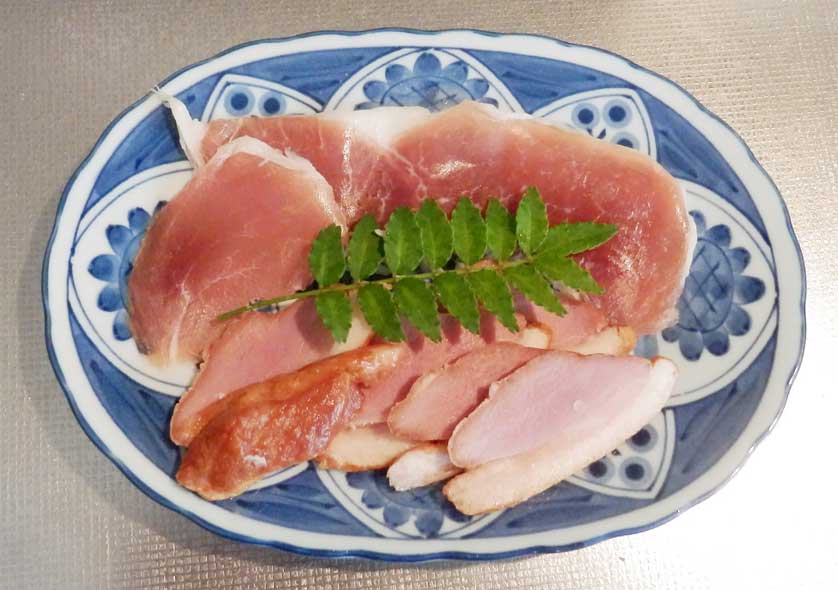
Sansho also works great on Western dishes like steak and other meats, it works perfectly with fish of all sorts as well as in salads. The edible leaves of the plant look delicious on any food platter - from sashimi to ham to cheese. The varieties of the use of sansho are almost endless with both Japanese and international dishes.

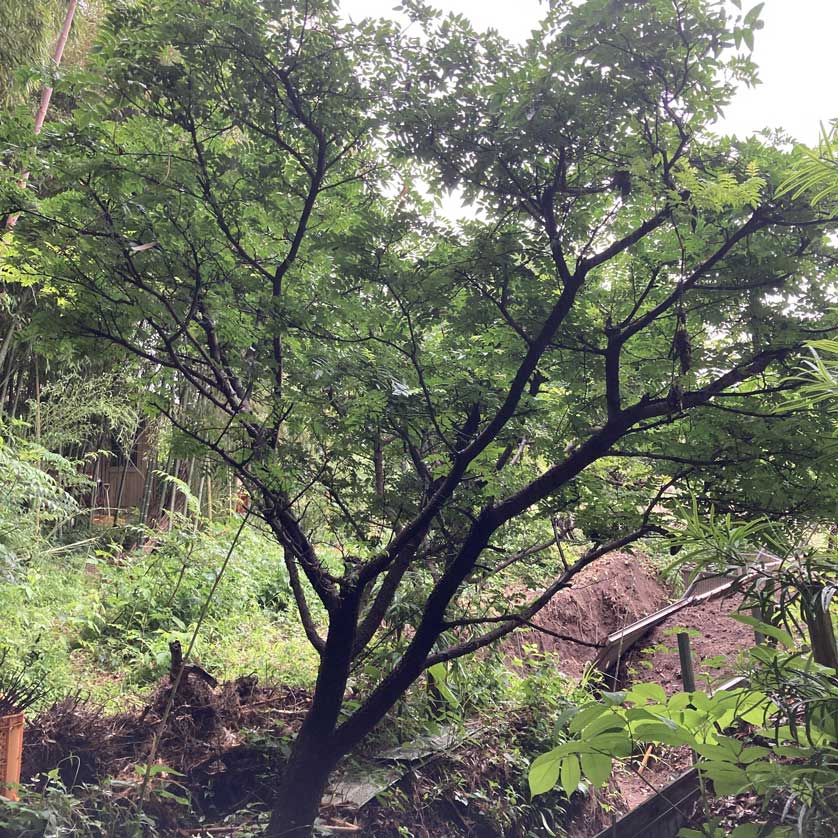
Sancho tree in Japan.
Sancho tree in Japan

What is Sansho?

Biologists use the Latin name Zanthoxylum piperitum for the plant. It is a tree which can grow up to three meters high. It can be easily recognized by its particular pinnated (feather-like) set of leaves and it sports long and quite sharp thorns.

The plant is native to Japan as well as parts of South Korea and a few areas in China. Known as chopi in Korean, sansho is also in heavy use in the cuisine of the Southern part of the peninsula.

Sansho is closely related to Sichuan peppers though their taste differs. Sichuan peppers fit the spicy foods of southwest China while sansho caters to the more subdued and refined tastes of Japan.

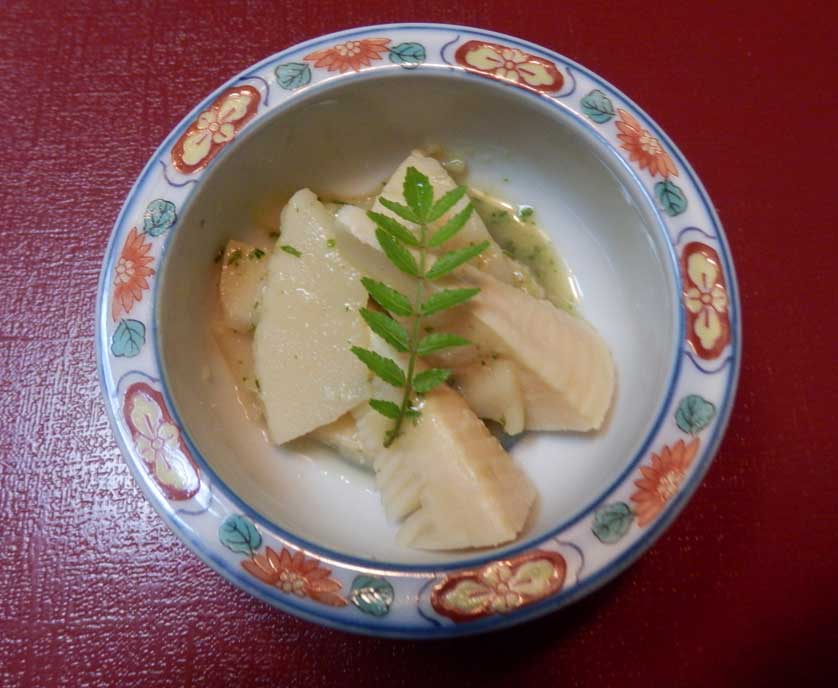
Bamboo sprouts with sansho leaves.
Bamboo sprouts with sancho leaves

Male and Female Plants

Sansho plants come in two varieties - male and female. Only the female plants feature blossoms (in about April), and only the female plants are able to grow fruits and seeds. Their leaves are larger, darker, and harder than those of their male counterparts.

The male plants on the other hand produce soft and light-colored leaves throughout the spring season. Those leaves are cherished in Japanese cuisine. In department stores, they are often sold in quite extravagant packaging for an according price.

Casual meat platter with sansho leaves.
Casual meat platter with sansho leaves

Sansho Leaves

This means that sansho from the male and female varieties is sold and used in quite different ways.

In April and May, male sansho leaves are available – going to a farmers' market you find them at a much lower price than at the department stores. Those leaves are fresh and they provide the very best of the sansho taste and smell. They are typically referred to as hana-zansho (flower sansho).

Typically, Japanese will place those leaves on one of their palms, then strongly clap hands. That brings out the full taste the best, it is said. If you get the chance to try your hand on that old custom, you will certainly attest to its veracity.

Those leaves go especially well with the fresh bamboo sprouts heading out of the ground at the same time.

They are very decorative and you often see them in advertising, sometimes used to advertise foods that call for sansho but are offered in different seasons. Like eel, a dish most commonly consumed in summer.

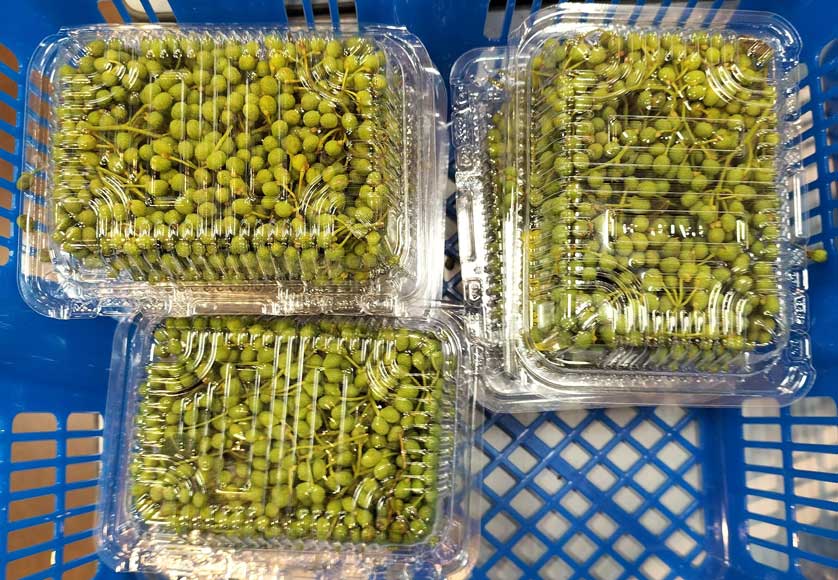
Unripe sansho fruits for sale in a Japanese farmers' market.
Unripe sansho fruits for sale in a Japanese farmers' market

Unripe Sansho Fruits

In June and July, unripe green sansho fruits become available at Japanese farmer's markets and department stores.

Those fruits, called ao zansho (green sansho) are often boiled in a broth with soy sauce and kombu (kelp) to make a tsukudani (rice topping). Mixed with tiny chirimen fish, they make great chirimen zansho, a famed Kyoto dish.

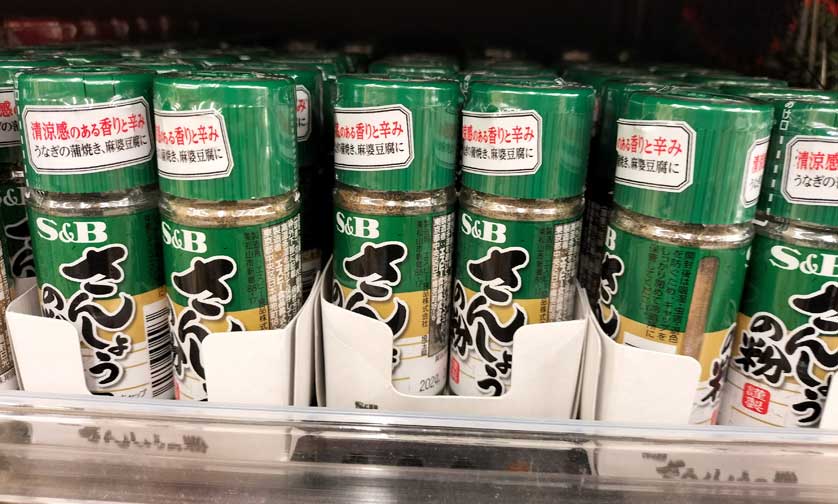
Ground sansho produced by SB on a Japanese supermarket shelf.
Ground sansho produced by SB on a Japanese supermarket shelf

Budoh Sansho

Sansho trees grow all over Japan from Hokkaido to Kyushu. The center of sansho production however is Wakayama Prefecture in Western Japan, south of Osaka. Wakayama cultivates about 80% of Japan's sansho.

Wakayama is also home to a special type of sansho, known as budoh sansho (grape shansho). The fruits of budoh sansho are much larger than average sansho fruits, they look more like grapes, hence the name. The budoh sansho variety is particularly sought after - it is not only larger but also offers a spicier taste than the average sansho.

Budoh sansho is sold both in unripe and in mature form.

Sansho rinds packed by Mascot.
Sansho rinds packed by Mascot

Ground Sansho

Harvest time for the ripe sansho fruits is in about October. That is when the by then dry reddish fruit rinds break open and reveal a black seed inside.

That seed is inedible and thus gets discarded. The valuable part of the fruit is the dry rind.

Most commonly that rind is ground into a more or less rough powder. Unlike the fresh leaves and unripe fruits, that powder can be purchased and used throughout the year.

Ground sansho is an elemental part of shichimi togarashi, ground sansho is no doubt the most commonly used form of sansho in Japanese kitchens today.

That's what is sprinkled on the dishes in summer in most eel restaurants, that's what you find as a condiment on the tables of Japanese udon and soba noodle restaurants.

The most common variety of ground sansho in Japan is the one manufactured by spice giant SB. Their sansho powder, labeled in hiragana letters as さんしょう, is available in every supermarket. That is the sansho most Japanese use at home.

Sansho Rinds

The main selling point of ground sansho is its convenience. You get the sansho taste on your dishes quickly and reliably.

For the real aficionado, however, ground sansho does not fly. Too much of the taste and fragrance of the sansho invariably evaporates during processing and storing.

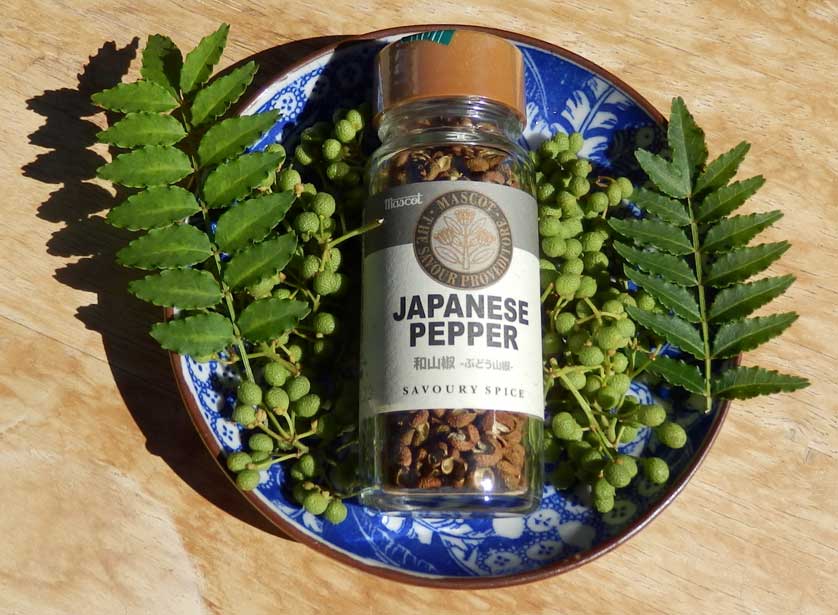
Under the name Japanese Pepper, Japanese spice maker Mascot sells the original dried rinds. Rinds of Wakayama budoh sansho, the large and spicy variation of the plant.

You get the real rinds tightly packed into a glass jar. Keep them dry and only use the portion for the meal you plan. Grind them in a suribachi mortar. The suribachi will bring out the best of the taste - especially if it is one of those traditional Japanese mortars that come with a pestle made of fragrant sansho tree wood.

Buy Sancho

Goods from Japan offers a variety of Japanese spices and condiments.

Buy ground sansho pepper from S&B

Buy sansho rinds from Mascot

Purchase a range of Japanese foodstuffs and drinks from GoodsFromJapan.

Related

Aizuwakamatsu Hand Painted Candles

Calpis

Cedar Leaf Incense

Cheese Tara

Ema Votive Plaques

Furikake Tsukudani Rice Topping Kinshobai

Happi Coats

Ishigaki Sea Salt

Japanese Chocolates

Japanese Mortar & Pestle Suribachi & Surikogi

Kaki no Tane

Kombu Japanese Kelp

Masu Wooden Sake Boxes

Ramune

Sayama Green Tea

Shichimi Togarashi

Yanai Goldfish Lanterns

Yatsuhiro & Tatami

Yuzu Kosho Spice from Kyushu

by Johannes Schonherr

© GoodsFromJapan.com

Sunday, February 01, 2026

Family Mart Line Socks

Family Mart Line Socks ファミリーマート ソックス

A rural Family Mart store.

Convenience stores are ubiquitous in Japan. In large cities you won't have to walk for more than a minute or two to reach the nearest konbini as they are called in Japan, the countryside is also dotted with them.

Convenience stores are generally open 24/7, in smaller towns they may be the only option to buy food, beer or cigarettes late at night. There, they are islands of light and warmth in a cold winter night.

The food on sale ranges from heated nikuman pork buns to bento boxes to onigiri rice balls to sandwiches to a large variety of snacks. Cheese tara are always on offer. The coffee is freshly brewed on site.

You can pay your bills at the counter. Yes, those electricity bills, etc. arriving at your home mailbox. You can ship packages from convenience stores, you can buy concert tickets there.

The ATMs at the convenience stores are usually the only ones processing foreign credit cards late at night, thus providing cash to foreign visitors at all times. Cash often needed at those cozy izakaya bars where cards are rarely accepted.

In short, Japanese convenience stores offer crucial lifelines at all times, even if all you need is a free, clean toilet or a free WiFi connection.

There are three major convenience store chains in Japan: Seven Eleven, Family Mart and Lawson. They all offer the same services, some details differ.

Family Mart

The Family Mart chain for example is famous for their roasted chicken, known as Famichiki.

Family Mart is the second largest of the three chains (Seven Eleven is the largest) and it has been an innovator in the industry since its inception.

The first Family Mart opened in 1973 near Iriso Station in Sayama City, just north of Tokyo. In the heart of the Sayama Tea area.

Today, Family Mart operates about 16,4000 stores in Japan and another 8,000 or so in foreign markets like Taiwan, Indonesia, Malaysia and the Philippines, there are close to 3000 stores in mainland China alone.

Socks at a Family Mart store.

Family Mart Apparel

What of the above makes Family Mart a fashion hub, though, you may rightly ask. Maybe a place to buy some fresh socks after a long hike in summer but not much more?

For decades, it was exactly like that. But then, Family Mart shifted gears. Fashion was to become one of their trademarks.

Basic fashion, of course, things residents and visitors alike needed quickly and on a daily basis. Like, yes, socks.

In 2021, Family Mart teamed up with Tokyo designer Hiromichi Ochiai and tasked him with a fashion line fitting the Family Mart image.

Family Mart Line socks

Family Mart Line Socks

Ochiai started out with the by now iconic Family Mart Line Socks. Thick unisex white socks made of wool and polyester, antibacterial and deodorizing, featuring towards their calf ends the green and blue lines that mark every Family Mart store.

People familiar with Family Mart (virtually everybody in Japan) would immediately recognize the source of the the socks. No logo was needed to achieve this effect.

Covid

The socks hit the shelves at the height of the Covid pandemic. It was a time when shopping trips went down to the barest minimum. People tried to avoid crowded trains, crowded department stores and so on and reduced their shopping to small stores in their immediate environs as much as possible.

Getting on a train to buy socks was out of the question. Many went to the convenience stores looking for reliable daily-use products beyond food and stationery.

That Family Mart was suddenly offering cheap, warm quality socks with a simple but easily recognizable design was greatly helpful at the time. People snapped them up and started to write about them on their blogs and in their discussion forums, creating quite a hype.

Convenience Wear

Meanwhile, Hiromichi Ochiai had bigger plans. In collaboration with Family Mart, he started a new fashion brand named Convenience Wear.

He designed towels, underwear, boxer shorts, T-shirts, sweat shirts, tank tops, hoodies, cardigans and even light jackets. All in basic black or white with a few sparse color lines thrown in. All quality products. Simple, durable, convenient.

If anyone wanted to, it would be possible to almost completely dress in Family Mart / Ochiai's Convenience Wear items.

Simpsons themed Family Mart Line socks.

Seasonal & Regional Products

Family Mart and Ochiai quickly understood that with the big fan base that had built up on the original Line Socks, seasonal and regional variations were to become much sought-after products.

That's exactly the way they went. Offering Line Socks with the colors of the lines geared towards the season, offering special editions for, say, the Fuji Rock Festival, as well as special editions for different regions. They also went into partnerships with the Simpsons and other major pop cultural players.

All of that of course being a tried and tested concept in Japan, best known in the food and snack sector.

It worked out with the Line Socks just as well, with fans searching out all the different varieties.

Foreign Visitors

Once the Covid pandemic was over, millions of foreign visitors entered Japan again. Soon more than ever before, lured by a cheap Yen and government policies focusing on aggressive tourist promotion.

The number of foreign visitors went through the roof. They are still getting higher year by year, all records are constantly broken.

Wherever those visitors are coming from, whatever their way of traveling is (tour group or individual?), they will all end up visiting a number of convenience stores during their stay in Japan.

Stores, they will tell stories about to their friends back home. Those always open, always reliable stores found to be everywhere.

Many of those visitors decided to buy their travel souvenirs right there at the convenience store rather than searching for something meaningful at a Buddhist temple or Shinto shrine.

The Family Mart Line Socks quickly caught their eyes. They were useful, they were easy to pack into the suitcase even in big amounts, they were profoundly Japanese. Insignias of the modern Japan. Easy and convenient gifts or memories.

That foreign visitors picked up the Family Mart Line Socks in such a great number led eventually major news outlets like the BBC in Britain and CNN in America to investigate the matter … publishing major online texts that further enhanced sales among visitors.

Whatever their wording, those news outlets all agreed on one basic thing: that, yes, the Family Mart Line Socks made great souvenirs / gift. Easy to purchase, convenient, useful, stylish… and absolutely Japanese.

Buy Iconic Convenience Socks from Japan

Goods from Japan offers a variety of Japanese clothing including tabi socks and tabi shoes.

Family Mart Line Socks in White & Black

Japanese gunsoku socks

Charcoal tabi socks

Purchase a range of Japanese footwear from GoodsFromJapan.

Japan SIM Cards From Mobal

Get a Japan SIM Card from Mobal

Related

Aizuwakamatsu Hand Painted Candles

Calpis

Cedar Leaf Incense

Ema Votive Plaques

Happi Coats

Ishigaki Sea Salt

Kaki no Tane

Masu Wooden Sake Boxes

Ramune

Sayama Green Tea

Shichimi Togarashi

Yanai Goldfish Lanterns

Yatsuhiro & Tatami

Yuzu Kosho Spice from Kyushu

by Johannes Schonherr

© GoodsFromJapan.com

Friday, January 23, 2026

Japan's Longest Day Book Review

Japan Book Review: Japan's Longest Day: Intrigue, Treason and Emperor Hirohito's Fateful Decision to Surrender

Japan's Longest Day

by Kazutoshi Hando and Yukinobu Hoshino

ISBN: 978-4-8053-1779-2
Tuttle Publishing, 2023 (English version)
480 pp; paperback

In the closing days of World War II, a few days after the atomic bombings of Hiroshima and Nagasaki had completely eviscerated any faint hopes that Japan could win or even continue the war, the Japanese cabinet met to discuss and vote on the surrender of Japan and acceptance of the conditions set out in the Potsdam Conference. The vote was a tie, and nobody knew what to do or what was next.

Finally, Emperor Hirohito took decisive action, telling the cabinet members that the war had been lost and Japan would agree to the surrender terms. The fighting would end.

However, not everyone agree. In fact, some high-ranking military leaders decided to try to overthrow Hirohito and his planned surrender, continuing the war until every single Japanese was dead, if necessary. That was the only "honorable" possibility. Known historically as the Kyujo Incident, Japan's Longest Day is about this incident.

Japan's Longest Day Book Review.

The day in question was August 14-15, 1945. Hirohito's recorded announcement of surrender was to be played on the 15th. On the night of the 14th Major Kenji Hatanaka and his men spent several hours searching for Hirohito's recording, a recording which was to be played for the nation at noon the next day. Unable to find the recording, the men occupied the NHK Building in an attempt to prevent the broadcast. Hatanaka had support from some factions of the military, but not quite enough to complete his coup. He abandoned the idea, went outside and killed himself.
It is important to know that while the general story is fairly well documented, parts of this graphic novel are speculation. The author opines that Hirohito had been blackmailed from the start to not oppose the war, even though he was generally against it. Potential historical reasons are given.

Two movies have been made about the Kyujo story: The 1967 film entitled, "Japan's Longest Day" and the 2015 film entitled, "The Emperor in August." Both movies are done in Japanese.

The overly picky could point out a few minor annoyances with the manga. First, there are half a dozen or so typos. Secondly, and perhaps it is a necessity and not an annoyance, is that the reader is swamped with many names and titles to keep straight.

One interesting touch is that the manga opens backwards from Western tomes, meaning the spine is on the right, not the left; so, the manga opens like old-style Japanese books did. This add to the authentic Japanese feeling of the manga, which was originally published in Japanese.

Japan's Longest Day is a gripping look at the anatomy of political decision-making under extreme duress. It shows that wars' conclusions can be as perilous and uncertain as wars' geneses. History buffs will be intrigued.

Review by Marshall Hughes, author of Rural Reflections: What 11 Years in Provincial Japan Taught Me.

Buy this book from Amazon USA | UK | Japan

Looking to buy Japanese things directly from Japan? GoodsFromJapan is here to help.

More Japan Book Reviews

All About Japan - Stories, Songs, Crafts and Games for Kids

Exposure: From President to Whistleblower at Olympus

Japanese Kokeshi Dolls: The Woodcraft and Culture of Japan's Iconic Wooden Dolls

Japanese Dolls: The Fascinating World of Ningyo

Memoirs of a Kamikaze

Rural Relections

The Snow Woman

Tokyo Outdoors

Saturday, January 03, 2026

Ishigaki Sea Salt Okinawa Japan

The Taste of the Southern Seas - Ishigaki Sea Salt 石垣島

by Johannes Schonherr

Ishigaki Sea Salt, harvested from the crystal clear waters of Nagura Bay on the subtropical island of Ishigaki in the far southwest of Japan is a strong-tasting, mineral-rich salt bringing the fragrance of Japan's southern seas right to your palate.

The fragrance of a southern island famous for its coral waters, fresh seafood but also for the beef raised further inland. It's a very fine, powder-like salt produced in a small local facility - but wait, maybe we should give the salt a bit of historical context first.

Ishigaki coastline, Okinawa.
Ishigaki coastline, Okinawa

History

Driving around the Japanese countryside, you sometimes spot a vintage grocery store proudly displaying the words 酒タバコ塩 in a prominent spot next to the name of the business. Those words mean "liquor, tobacco, salt". They also signify that the business had its full accreditation afforded by the government since liquor, tobacco, and salt were under strict state control.

While this is still the case with liquor and tobacco, the Japanese government eventually relaxed the regulations in the case of salt. In 1997, the government lifted all restrictions.

Ishigaki sea salt factory.
Ishigaki sea salt factory

Soon, small privately-owned sea salt processing facilities sprang up all along Japan's coasts. Stop at any rural seaside michi-no-eki (roadside rest house featuring a permanent and often quite large local farmer's market) and you will find packages of the locally produced sea salt.

From Okhotsk Sea Salt on the northern shore of Hokkaido taken from the waters bordering Siberia all the way down the non-industrial areas of the Sea of Japan coast to Kyushu. There, Amakusa Sea Salt from the Amakusa Islands in Nagasaki is especially sort after. The scenic Japanese Inland Sea has its very own culture of producing sea salt and so does Okinawa.

With that great diversification of locally produced salts, soon a Japanese salt gourmet culture sprang up. People began to compare which salt fitted which dishes best. Salt aficionados took long tours to visit famous salt spots to build up salt collections for their kitchens - so they could choose which salt to use for which dish.

Salt cooker and salt processing by hand.
Salt cooker and salt processing by hand

Okinawa

Okinawa became the center of this salt-sampling culture. Paradise Plan, a small company producing especially mild sea salt in a flaky form named Yukishio (Snow Salt) on the island of Miyakojima, was the first to act on the trend. They opened a store named Masuya (salt store) in Naha, the capital of Okinawa, offering 120 kinds of salt sourced worldwide.

From Himalayan rock salt to North American and Mediterranean to obscure stone salts hammered out of the Argentinian Andes, the Naha Masuya had it all. Still, their focus was on local Okinawa salts. By now, you can find Masuya salt stores in Tokyo and other major Japanese cities, employing salt sommeliers who take care of all your salty needs.

Salt cleaning by hand.
Salt cleaning by hand

Ishigaki Sea Salt

One of the most featured salts in any Masuya store is Ishigaki no Shio, Ishigaki Sea Salt from the island of Ishigaki in the Yaeyama archipelago in southern Okinawa.

Located close to Taiwan, Ishigaki has its very own traditional culture. The Yaeyama Islands were once home to 13 different languages, most of them today being considered extinct or close to it.

Walking through the market in Ishigaki City, however, you will overhear plenty of frantic haggling using speech that is decidedly neither Japanese nor Chinese. Those market ladies still make good use of those old languages academic linguists keep worrying about.

Sun drying Ishigaki salt.
Sun drying Ishigaki salt

Enter Tokuhide Togo, a native of the island. A former diver, he was always interested in what the sea had to offer. After the liberation of the salt law in 1997, he turned his occasional experiments with extracting salt from the sea into a business.

Togo's Ishigaki Salt has a much stronger taste than the Miyakojima salt and is a fine powder, applicable to everyday use and simply called Ishigaki no Shio (Ishigaki Salt).

Visitors to the small factory are welcome. There is a small on-site store selling not only the salt in its various forms but also sweets produced using the salt. Delicious stuff. Ishigaki salt cookies are highly recommended.

Ishigaki Sea Salt production steps.
Ishigaki Sea Salt production steps

A diagram explains, in brief, the patented manufacturing method of the salt: seawater is taken from the bay, sand and stones are filtered out, the water is collected in a tank. The water gets evaporated, thus concentrating the salt. The salt is dried in a sunlit room. Then, it's on to packing and the product is ready for sale.

Pipes take fresh water from the sea.
Pipes take fresh water from the sea

A large glass front gives you a peek inside the main processing room where you can see workers in protective gear handle the salt. Stroll down to the shore. There you see two pipes leading into the clean natural bay. Those are the pipes that take the seawater in for salt production. In the far distance, you see another, smaller but hilly island. To the right, you can see the Omoto-dake, at 526 meters the highest mountain in all of Okinawa. From there, the Nagura River flows down into the sea, assuring a constant cleaning of the water in the bay. Quite a peaceful scenery.

Purchase Ishigaki salt from GoodsFromJapan.com.
Purchase Ishigaki salt from GoodsFromJapan.com

Buy Ishigaki Sea Salt

While a visit to the Ishigaki Sea Salt factory is highly recommended, you can easily buy the salt online from Goods from Japan.

If you are interested in other Japanese sea salts as well, building up a small collection for your kitchen, Goods from Japan will cater to all your needs. Just contact us, we are more than happy to help.

Japan SIM Cards From Mobal

Get a Japan SIM Card from Mobal

Related

Calpis

Ema Votive Plaques

Furikake Tsukudani Rice Topping Kinshobai

Happi Coats

Hoshigaki

Japanese Mortar & Pestle Suribachi & Surikogi

Kaki no Tane

Masu Wooden Sake Boxes

Sayama Japanese Green Tea

Shichimi Togarashi

Yatsuhiro & Tatami

Yuzu Kosho Spice from Kyushu

© GoodsFromJapan.com

Thursday, December 25, 2025

Mashi: The Unfulfilled Baseball Dreams of Masanori Murakami

Japan Book Review: Mashi: The Unfulfilled Baseball Dreams of Masanori Murakami, the First Japanese Major Leaguer

Mashi: The Unfulfilled Baseball Dreams of Masanori Murakami, the First Japanese Major Leaguer

by Robert K. Fitts

ISBN: 978-1-4962-1951-0
University of Nebraska Press, 2014
232 pp; paperback

Part-pioneer, part-legend, part wide-eyed innocent kid and (unintentionally) part-baseball troublemaker, Japan's Masanori "Mashi" Murakami had one of the most interesting and consequential careers in baseball history.

In 1964, the Nankai Hawks of Japan's Pacific League sent their promising 19-year-old left-handed pitcher with two other young players to America to improve their skills. While the two other players struggled, Murakami thrived for the Class A (low minor leagues) Fresno Giants, the San Francisco Giants' affiliate.

Mashi: The Unfulfilled Baseball Dreams of Masanori Murakami.

On August 29, Murakami struck out 10 of the 12 batters he faced for a four-inning save. By September 1st, he was pitching in the majors.

The S.F. Giants, deep in a pennant race, desperately needed a left-handed reliever, so bypassing their AA and AAA players, they shockingly called up Murakami. Murakami was thrust into high-pressure situations armed with little more than a savage curveball and pinpoint control. He spoke very little English and knew next to nothing about America.

At that season's end, the Giants offered Murakami a contract for the 1965 season. He quickly signed, even though he was then unable to read English. Problematically, he was already under contract to return to the Nankai Hawks for the 1965 season. The conflict quickly drew the attention of both Japan and America's baseball commissioners, and a legal battle ensued.

It was finally decided that Mashi would pitch for San Francisco for one more year, then return to Japan. Still, the bad blood between the two commissioners and the two leagues resulted in no more Japanese players being allowed to play in America for 30 years. The next Japanese to play in America was the famous Hideo Nomo.

Author Fitts' research for the book is remarkable. He interviewed Murakami three times over a period of 10 years, and gained access to Murakami's diaries. Other players and team personnel made themselves available for interviews, too, and Fitts must have spent many hours poring through old newspaper clippings.

The details on a number of famous incidents – for example the Giants-Dodgers game in 1965 where Giants' star pitcher Juan Marichal cracked Dodgers' catcher John Roseboro over the head with his bat - are fantastic. As a former sportswriter myself who grew up near San Francisco, I knew a lot about this incident, but still got some new information from Fitts.

The book is not just about baseball. There are numerous insights into 1960s social turmoil, but not enough to slow down the pace of the book. Of course, Murakami's personal life is covered, too, starting from when he was just four years old.

The appendix (filled with Murakami's stats) and attributions to his research are impressive.

Note: Mashi is one of three books written by Fitts about Japan and baseball. The others are Banzai Babe Ruth: Baseball, Espionage, and Assassination During the 1934 Tour of Japan, and Wally Yonamine: The Man Who Changed Baseball. These books can be purchased by clicking on the links above.

Review by Marshall Hughes, author of Rural Reflections: What 11 Years in Provincial Japan Taught Me.

Buy this book from Amazon USA | UK | Japan

Looking to buy Japanese things directly from Japan? GoodsFromJapan is here to help.

More Japan Book Reviews

All About Japan - Stories, Songs, Crafts and Games for Kids

Exposure: From President to Whistleblower at Olympus

Japanese Kokeshi Dolls: The Woodcraft and Culture of Japan's Iconic Wooden Dolls

Japanese Dolls: The Fascinating World of Ningyo

Rural Relections

The Snow Woman

Tokyo Outdoors

Saturday, November 08, 2025

A Geek in Japan Book Review

Japan Book Review: A Geek in Japan: Discovering the Land of Manga, Anime, Zen, and the Tea Ceremony

A Geek in Japan: Discovering the Land of Manga, Anime, Zen, and the Tea Ceremony

by Hector Garcia

ISBN: 978-4-8053-1129-5
Tuttle Publishing, 2010
160 pp; paperback

A Geek in Japan is a vibrant, visually stunning guide exploring Japanese culture through the eyes of, it would appear, a knowledgeable, hardcore Japanophile, who melds tradition and modernity with enthusiasm and insight.

Helping the book's appeal is its large size of 19x25 cm, or 7.5x10 inches. This allow for hundreds of large, colorful and easy-to-see photos. The sidebars and infographics are equally impressive.

A Geek in Japan.
A Geek in Japan

The book covers a lot of ground, starting with the origins of Japanese culture, the traditional arts and the unique Japanese character, including the famous work culture. Then, the geekier parts kick in with sections on society today, the world of manga and anime (what would a book about geeks and Japan be without discussing manga and anime?), modern music and media, and finally travel in Japan in general and in Tokyo in specific.

One of the book's strong suits is its handling of Japanese aesthetics and values; for example ideas such as wabi-sabi (the art and beauty of imperfection) and omotenashi (hospitality), which are found in everything from architecture to interpersonal relationships. Of course, Japan's two major religions of Shinto and Buddhism are discussed, including how they coexist and still influence festivals and daily rituals.

While most of the book is fun and entertaining, there are a few places that dip into the darker side of Japan; for example, suicides and their aftermath, especially for those who cease their existence by jumping in front of trains in Tokyo. Sometimes, their families are fined up to ¥100 million "to cover the cost of cleaning services and delays across the lines."

There are only two possible "issues" about the book, and both are pretty insignificant.

First, since the book was published in 2010, there are a few things that are a bit dated. Tsukiji, long known as the place for 5 a.m. trips to see the active fish market, has closed down. Also, while listing "current" singers and groups, the names Orenji Renge and Kumi Koda among others are mentioned. Today's young and hip probably don't know these names. Also, Yamamba and other short-lived fashions are a bit out of date.

Second, while an impressive number of subjects are covered, none are covered in depth, as no section extends beyond one page. Still, that is a little like criticizing McDonalds for not serving gourmet food: that's not the purpose of the whole thing.

Even self-declared Japanophiles can learn something from the book. After all, who among us can quickly explain the difference between gothic, amaloli, classic, wa, qi and erotic lolitas?

Overall, this book never disappoints.

A Geek in Japan is one of a series of books by Tuttle Publishing. There are also similar looking and similarly laid out "Geek" books about Korea, Thailand, China and Indonesia.

Review by Marshall Hughes, author of Rural Reflections: What 11 Years in Provincial Japan Taught Me.

Buy this book from Amazon USA | UK | Japan

Looking to buy Japanese things directly from Japan? GoodsFromJapan is here to help.

More Japan Book Reviews

All About Japan - Stories, Songs, Crafts and Games for Kids

Exposure: From President to Whistleblower at Olympus

Goodbye Madam Butterfly: Sex, Marriage and the Modern Japanese Woman

Japanese Kokeshi Dolls: The Woodcraft and Culture of Japan's Iconic Wooden Dolls

Japanese Dolls: The Fascinating World of Ningyo

Mashi: The Unfulfilled Dreams of Masanori Murakami

Rural Relections

The Snow Woman

Tokyo Outdoors

Katsuobushi & Katsuobushi Kezuriki

Bonito Flakes in the Kitchen: Katsuobushi and the Katsuobushi Kezuriki 鰹節と鰹節削り器

Katsuobushi fillet and katsuobushi kezuriki.
Katsuobushi fillet and katsuobushi kezuriki

Remember the first time you were served okonomiyaki (Japanese pancakes) in one of those dark, dingy, tiny but homely restaurants in Osaka? The first time you received a boat of takoyaki (wheat batter balls containing a piece of octopus)? Did you wonder what those wildly fluttering flakes on top of the dish? Those flakes almost seem to have a life of their own! It's the heat of the dishes underneath that makes them vibrate.

Those flakes are called katsuobushi and you encounter them in Japan quite frequently and in many different ways. They are used as soup stock, mixed with rice in onigiri rice balls and as topping on an endless variety of dishes ranging from tofu to soba noodles to meat (especially chicken), more recent recipes even include them as toppings on avocado and other imported foods.

Katsuobushi fillets from GFJ.
Katsuobushi fillets

What is Katsuobushi?

Now, what are those katsuobushi? Roughly translated, katsuobushi means dried bonito flakes. Katsuo is the Japanese name for the skipjack bonito, a fish belonging to the tuna family.

The best meat of those fish, usually caught in the waters surrounding southern Japan, is filleted by hand and knife. Work that needs quite some skill. An experienced worker cuts the fillets from the fish in less than a minute.

Those fillets are then simmered close to the boiling point for an hour or more, then wood smoked up to a month. A smoking session lasts about six hours, then the fillet rests for a day. This process is repeated for about 12 to 15 times. Finally, the fillet is sun-dried for about two weeks with the help of a special mold, the Aspergillus glaucus. The mold ferments the fillet and removes any residual moisture.

When ready for sale, those fillets are hard as wood and brown on the outside, resembling short sticks of firewood. On the inside, they are a blackish purple. After scraping a section of the fillet, the exposed parts glisten in the light like dark, colored glass.

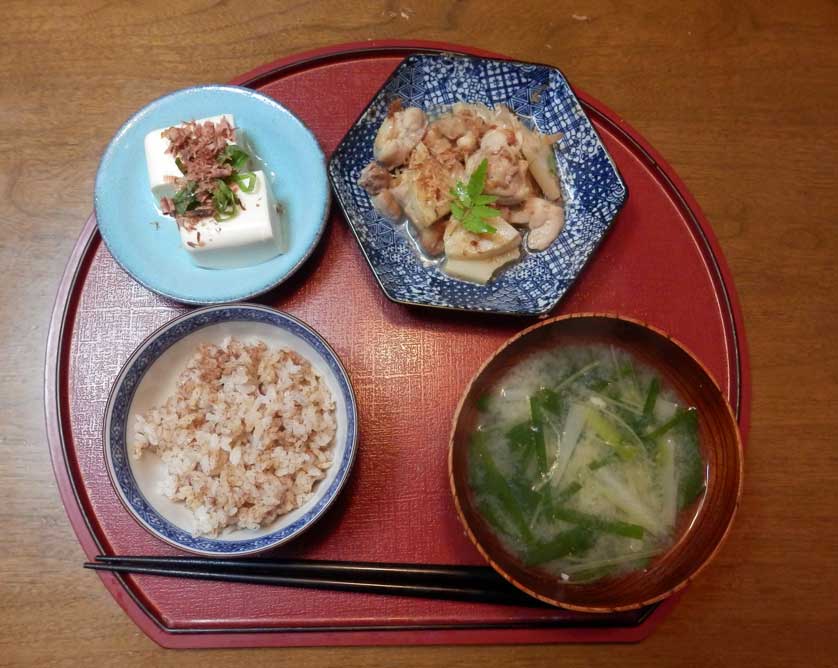
Katsuobushi-centered meal. Katsuobushi-topped tofu, katsuobushi-topped bamboo sprouts, rice mixed with katsuobushi, miso soup using katsuobushi stock.
A katsuobushi-centered meal: katsuobushi-topped tofu, katsuobushi-topped bamboo sprouts, rice mixed with katsuobushi, miso soup using katsuobushi stock

History

Dried bonito is as old as Japan. The most ancient books refer to it as do the legends of the Ainu, the original inhabitants of the islands. Dried bonito could be stored for a long period, it was easy to transport, it was very nutritious and it was very tasty when mixed with rice. That ancient dried bonito was however not the same as the katsuobushi flakes in use today.

Those were invented by a man named Jintaro Kadoya in the Kumano domain (today's Wakayama Prefecture) in the mid-1600s. Kadoya came up with the concept of fumigating the katsuo fillets to preserve them in the best possible way.

Not finding the success with his invention he had hoped for in his native Kumano, Kadoya moved to the Tosa domain on the southern shore of Shikoku (today's Kochi Prefecture). There, the bonito catches were better and the locals embraced Kadoya's production method.

Producing katsuobushi in Tosa proved to be very challenging, however. The climate was wet and mold easily settled on the fillets when set out for sun-drying.

But soon, the Tosa locals producing katsuobushi in Kadoya's way learned how to deal with that ever pervasive mold. They incorporated the mold into the production process, turning the mold from a nuisance into the final step of refinement.

Tosa katsuobushi soon became all the rage on the markets of Edo and Osaka.

The production process was a closely guarded secret but that secret soon leaked out to the Satsuma domain (today's Kagoshima Prefecture). Production conditions in Kagoshima were very similar to those of Tosa (Kochi).

Katsuobushi kezuriki.
Traditional katsuobushi kezuriki

Famous Production Areas

Kochi and Kagoshima Prefectures are still the main producers of katsuobushi today. They got the brand name recognition, they got the history and the experience of family-run firms dealing with the product for centuries.

Shaving the Katsuobushi

Most common today are factory-shaved katsuobushi flakes. Those are sold in plastic bags in all Japanese supermarkets and they are the most easy to use.

It’s more fun, though, to produce the katsuobushi flakes in your kitchen by yourself. To do so, you need a special tool to shave the flakes from the wood-like katsuobushi fillet.

Traditionally, for this purpose a katsuobushi kezuriki is used. Essentially, that’s a wooden box with a blade inserted. You move the katsuobushi fillet with a certain amount of strength over the blade functioning as a sort of wood plane. The shaved-off flakes are collected in the drawer below the blade.

Working the blade needs a certain amount of practice, though. You need to figure out how exactly to hold the fillet stick and what amount of pressure to apply. If done incorrectly, the result of the shaving will be rather a reddish rough powder than the desired flakes.

That powder is delicious and can be used in salads, for example. But you wanted the flakes, right? The real thing.

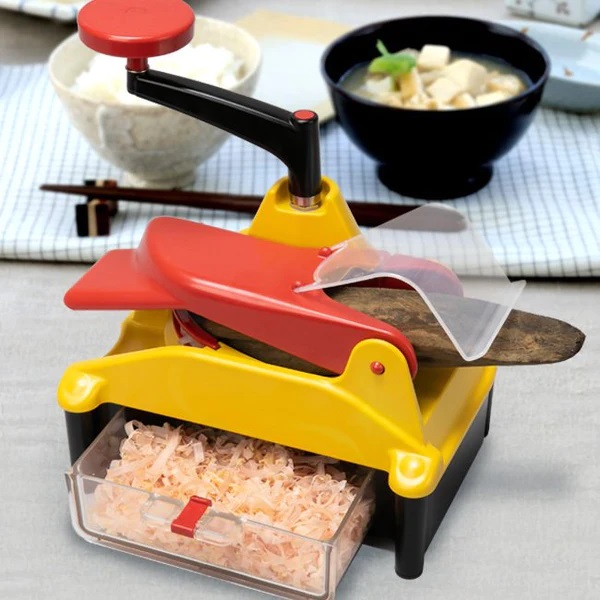
Those can be more easily produced using a mechanic katsuobushi shaving machine. Of course, the mechanic shaver leaves you a little short on the experience of cooking in real traditional Japanese style but it provides you with the desired result easily and efficiently.

Katsuobushi fillet and katsuobushi kezuriki.
A katsuobushi fillet and katsuobushi kezuriki

Buy Katsuobushi

Goods from Japan offers all the options, the wood-like fillet sticks and the old-style kezuriki as well as two kinds of mechanic shavers, one named the Okaka and the other the Kakuta-Kun, and of course, the most easy-to-use bagged factory-made katsuobushi flakes.

Purchase a range of Japanese foodstuffs and drinks from GoodsFromJapan.

Japan SIM Cards From Mobal

Get a Japan SIM Card from Mobal

Related

Calpis

Cedar Leaf Incense

Ema Votive Plaques

Furikake Tsukudani Rice Topping Kinshobai

Happi Coats

Ishigaki Sea Salt

Japanese Chocolates

Japanese Mortar & Pestle Suribachi & Surikogi

Kaki no Tane

Kombu Japanese Kelp

Masu Wooden Sake Boxes

Ramune

Sancho

Sayama Green Tea

Shichimi Togarashi

Yanai Goldfish Lanterns

Yatsuhiro & Tatami

Yuzu Kosho Spice from Kyushu

by Johannes Schonherr

Katsuobushi Shaving Machine Kakuta-kun.
Purchase a Katsuobushi Shaving Machine Kakuta-kun

© GoodsFromJapan.com